

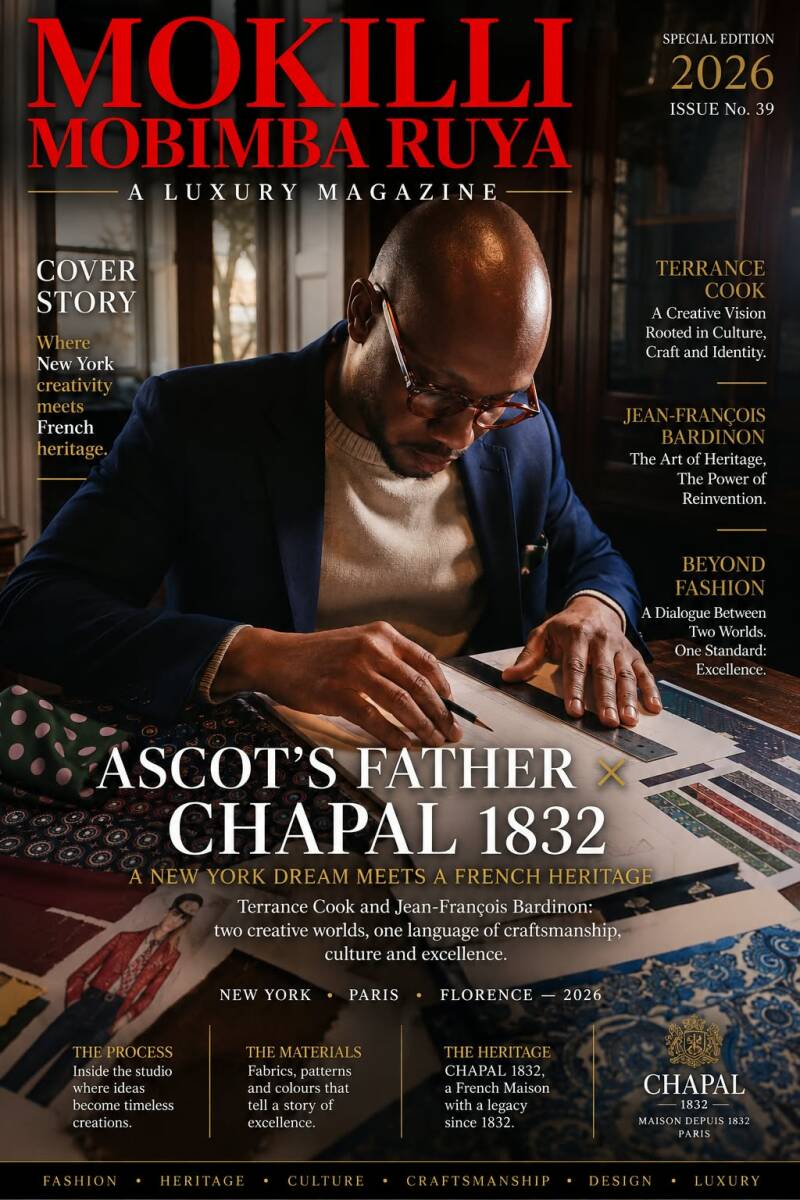
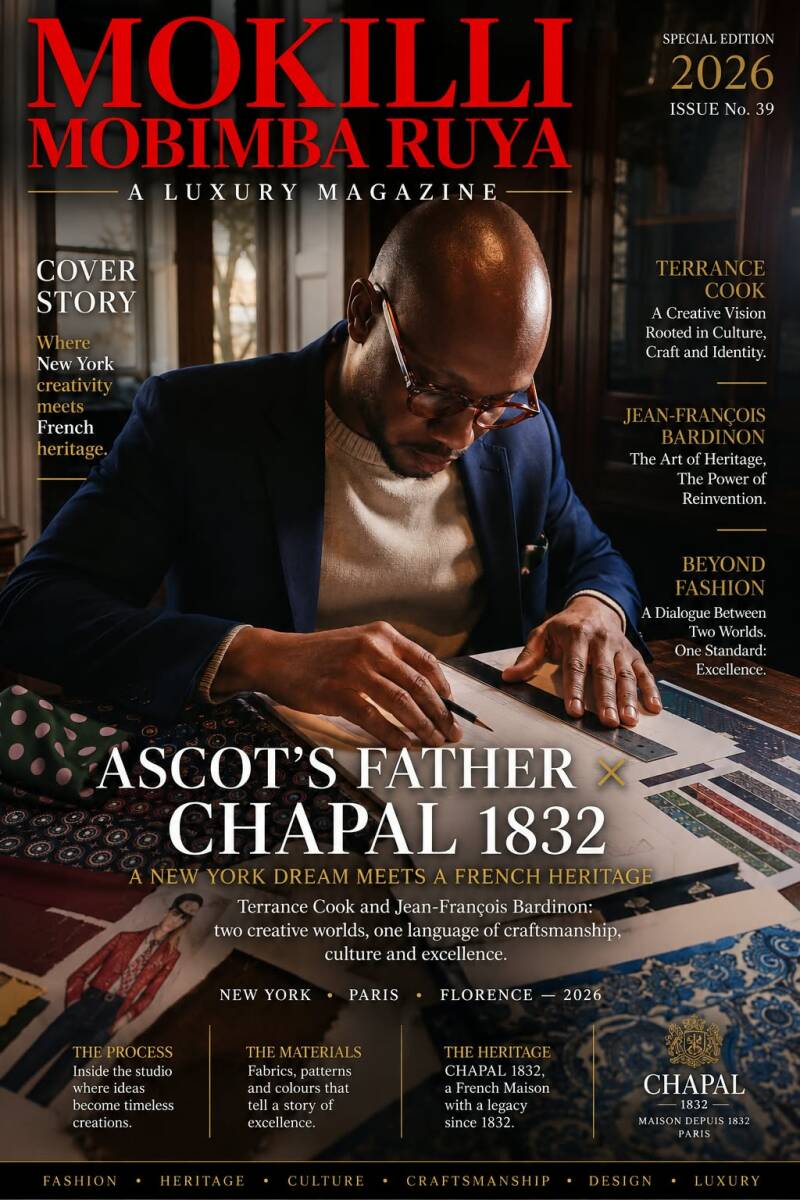
MOKILI MOBIMBA RUYA — A LUXURY MAGAZINE
SPECIAL EDITION 2026 · ISSUE No. 39
ASCOT’S FATHER X CHAPAL 1832
A NEW YORK DREAM MEETS A FRENCH HERITAGE
Terrance Cook and Jean-François Bardinon: two creative worlds, one language of craftsmanship, culture and excellence.
NEW YORK · PARIS · FLORENCE — 2026
THE ENCOUNTER
There are collaborations that begin with a product. Others begin with a conversation.
ASCOT’S FATHER × CHAPAL 1832 belongs to the second category.
Across the Atlantic, two creative perspectives meet around a shared conviction: that luxury is not simply about appearance, but about craftsmanship, cultural memory, material intelligence and the freedom to create something personal.
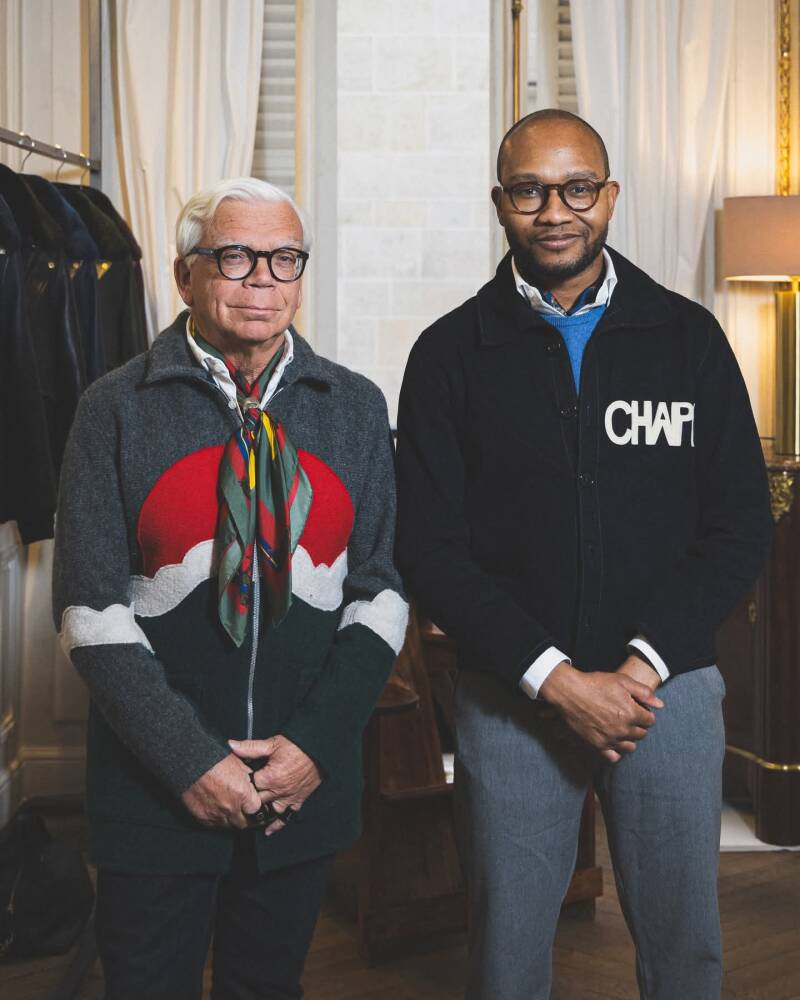
At the centre of this encounter are Terrance Cook, the New York-based designer and Creative Director behind ASCOT’S FATHER, and Jean-François Bardinon, President and Artistic Director of Maison CHAPAL 1832.
Their worlds are different in geography and history, yet remarkably close in spirit.
New York brings energy, movement and contemporary creative culture.
France brings heritage, discipline and an extraordinary relationship with craftsmanship.
Between them emerges a new creative dialogue.
ASCOT’S FATHER
THE NEW YORK CREATIVE SPIRIT
Terrance Cook approaches fashion as a space where ideas, images, textiles and identity can coexist.
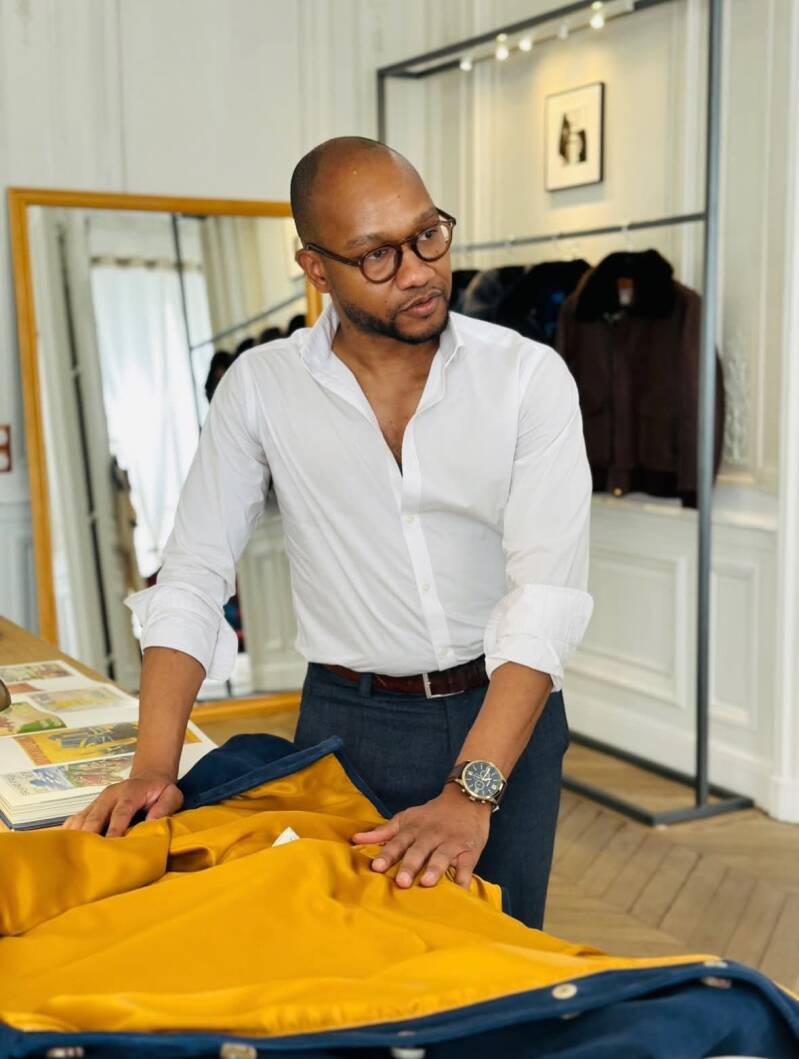
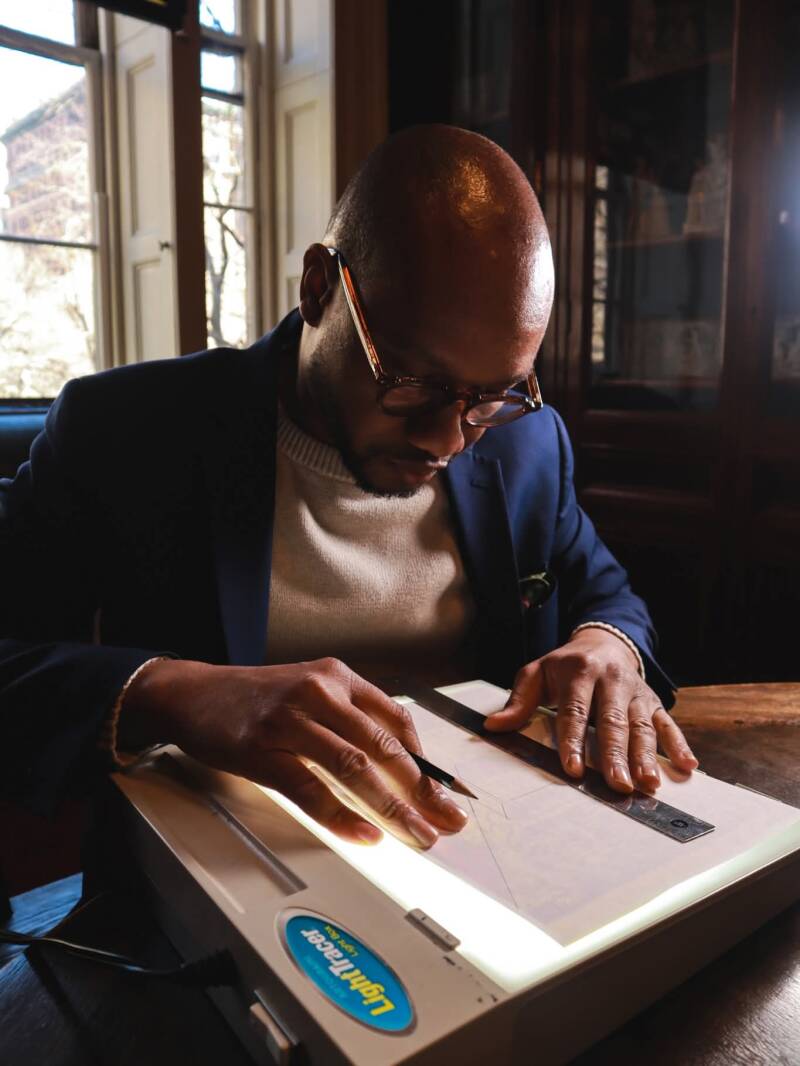
The photographs accompanying this story reveal a designer immersed in the process: studying fabrics, examining patterns, comparing colour references, working with illustrations and transforming visual ideas into a coherent design language.
Here, the studio becomes a laboratory.
Fabric is not simply fabric.
A colour becomes a statement.
A pattern becomes a signature.
A silhouette becomes an attitude.
The creative process is visible in every detail: from the selection of printed textiles to the arrangement of colour cards, from hand-drawn figures to the careful examination of materials.
This is where the idea of a garment begins — long before it reaches the finished form.
THE ART OF SEEING
The strongest designers possess an ability that cannot easily be taught: the ability to see relationships between apparently unrelated things.
A colour on a textile.
A historical reference.
A drawing.
A silhouette.
A cultural memory.
A contemporary city.
Cook's creative environment reflects precisely this approach.
His work appears to move between tailoring, illustration, textile research and visual storytelling. The studio photographs show an intimate process in which materials are touched, compared, selected and reconsidered.
The result is not merely clothing.
It is a visual language.
CHAPAL 1832
WHEN HERITAGE BECOMES A CREATIVE DIALOGUE
The presence of Maison CHAPAL 1832 introduces another dimension to the story.
Represented here by Jean-François Bardinon, President and Artistic Director, the French house brings the weight of a long-established heritage into conversation with a contemporary New York creative vision.
The significance of such an encounter lies precisely in the contrast.
Heritage can easily become static when it is treated only as something to preserve.
But heritage becomes powerful when it is reinterpreted.
The meeting between ASCOT’S FATHER and CHAPAL 1832 therefore suggests a different model of luxury: one in which history does not restrict creativity, but gives it a deeper foundation.
FROM THE SWATCH TO THE SILHOUETTE
The visual material from the creative process tells an important story.
There are textile boards filled with geometric motifs, paisleys, dots, florals and graphic compositions.
There are colour references — deep blues, reds, greens, ochres and neutrals.
There are fashion illustrations placed alongside fabric samples.
And there is the designer's hand continuously moving between these elements.
This is the invisible architecture of fashion.
Before a collection becomes an image, it exists as a series of questions:
Which colour?
Which proportion?
Which pattern?
Which texture?
Which attitude?
The designer's responsibility is to transform those questions into a coherent visual identity.
THE MATERIAL SPEAKS
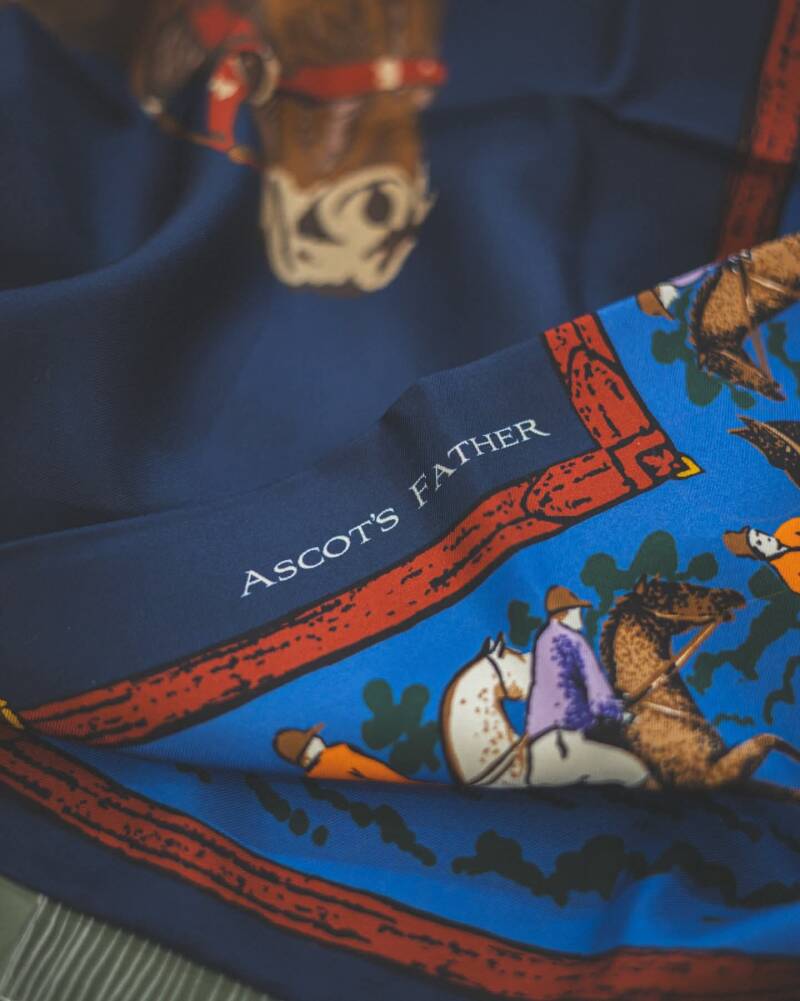
The fabrics photographed throughout the creative process are particularly revealing.
Patterns are not treated as decoration alone. They become structural components of the concept.
A dark ground can create restraint.
A strong geometric motif can introduce rhythm.
A contrasting colour can completely change the personality of a garment.
A traditional pattern can acquire a contemporary identity through scale, placement and combination.
This is where craftsmanship and creativity meet.
The fabric provides the vocabulary.
The designer writes the sentence.
NEW YORK × FRANCE
The relationship between New York and French fashion has always been shaped by exchange.
New York represents speed, experimentation and cultural multiplicity.
French creative heritage represents refinement, technique and continuity.
ASCOT’S FATHER × CHAPAL 1832 places these two energies in the same creative conversation.
The result is neither a simple American interpretation of French heritage nor a French response to New York fashion.
It is something more interesting:
a dialogue between cultures.
THE CREATIVE DIRECTOR AS CULTURAL TRANSLATOR
For Terrance Cook, the role of Creative Director extends beyond designing garments.
It involves translating references.
Translating colour into emotion.
Translating history into contemporary form.
Translating personal experience into a visual language capable of travelling across borders.
This is particularly relevant in an international luxury landscape where consumers increasingly look beyond conventional definitions of fashion.
They want authenticity.
They want stories.
They want craftsmanship.
And, increasingly, they want to understand where an object comes from and why it exists.
JEAN-FRANÇOIS BARDINON
HERITAGE WITH A FUTURE
The involvement of Jean-François Bardinon gives the encounter an important cultural dimension.
As President and Artistic Director of CHAPAL 1832, he represents a perspective in which heritage and artistic direction can coexist.
The meeting with Cook creates an opportunity to look at heritage differently — not as a museum object, but as a living creative resource.
The question is no longer simply:
“How do we preserve tradition?”
It becomes:
“How can tradition continue to inspire?”
That distinction is at the heart of contemporary luxury.
THE NEW LANGUAGE OF LUXURY
Luxury today is increasingly defined by what cannot be immediately measured.
Time.
Knowledge.
Craftsmanship.
Provenance.
Creative authorship.
Attention to detail.
The photographs from the ASCOT’S FATHER studio communicate precisely this slower dimension of creation.
A hand selecting a fabric.
A pencil defining a silhouette.
A magnifying glass examining a detail.
A designer comparing colour references.
These are quiet gestures.
But they are the gestures from which exceptional objects are born.
A SHARED PHILOSOPHY
What connects ASCOT’S FATHER and CHAPAL 1832 is ultimately not geography.
It is philosophy.
Both perspectives recognise that craftsmanship becomes meaningful when it carries culture.
The objective is not to reproduce the past.
Nor is it to reject the past in the name of novelty.
The objective is to create a bridge.
Between generations.
Between cities.
Between techniques.
Between imagination and material.
Between New York and France.
THE POWER OF COLLABORATION
The most compelling collaborations do not erase differences.
They reveal them.
The New York energy of ASCOT’S FATHER meets the French heritage of CHAPAL 1832.
Contemporary creativity meets historical knowledge.
Graphic experimentation meets craftsmanship.
Personal expression meets institutional heritage.
And somewhere between these opposing forces, a new aesthetic vocabulary begins to emerge.
BEYOND FASHION
This story is ultimately larger than fashion.
It is about cultural exchange.
It is about the possibility of creating something new without abandoning the knowledge that came before.
It is about designers and creative leaders becoming interpreters of culture.
And it is about luxury evolving from a language of exclusivity into a language of meaning, authorship and excellence.
THE MOKILI MOBIMBA RUYA VIEW
At MOKILI MOBIMBA RUYA, we believe that the future of luxury will belong to those capable of connecting worlds.
Africa and Europe.
America and France.
Heritage and innovation.
Craftsmanship and contemporary culture.
The ASCOT’S FATHER × CHAPAL 1832 encounter embodies this philosophy.
It is a story of two creative worlds meeting without losing their individuality.
A story of materials, patterns, sketches and ideas.
A story of heritage becoming contemporary.
And, above all, a story about the people who transform imagination into something tangible.
ASCOT’S FATHER × CHAPAL 1832
A NEW YORK CREATIVE VISION MEETS A FRENCH HERITAGE OF CRAFTSMANSHIP
Terrance Cook
Designer · Creative Director
ASCOT’S FATHER
×
Jean-François Bardinon
President · Artistic Director
CHAPAL 1832
NEW YORK · PARIS · FLORENCE — 2026
MOKILI MOBIMBA RUYA
A LUXURY MAGAZINE
SPECIAL EDITION 2026 · ISSUE No. 39
THE WHOLE WORLD IS BEAUTIFUL
Fashion · Heritage · Craftsmanship · Culture · Design · Luxury
#AscotsFather #CHAPAL1832 #MaisonChapal #TerranceCook #JeanFrancoisBardinon #LifeWellCrafted #LuxuryFashion #LuxuryDesign #LuxuryLifestyle #Craftsmanship #SavoirFaire #Heritage #LuxuryHeritage #ArtAndFashion
#LuxuryMagazine #GlobalLuxury #LuxuryEditorial #LuxuryCulture #FashionEditorial #FashionCulture #LuxuryBrand #ContemporaryLuxury #HighEndFashion #Menswear #LuxuryMenswear #Designer #CreativeDirector
Business trainer and coach in cross-cultural communications, business mediator, lecturer and expert in international negotiations.
Add comment
Comments